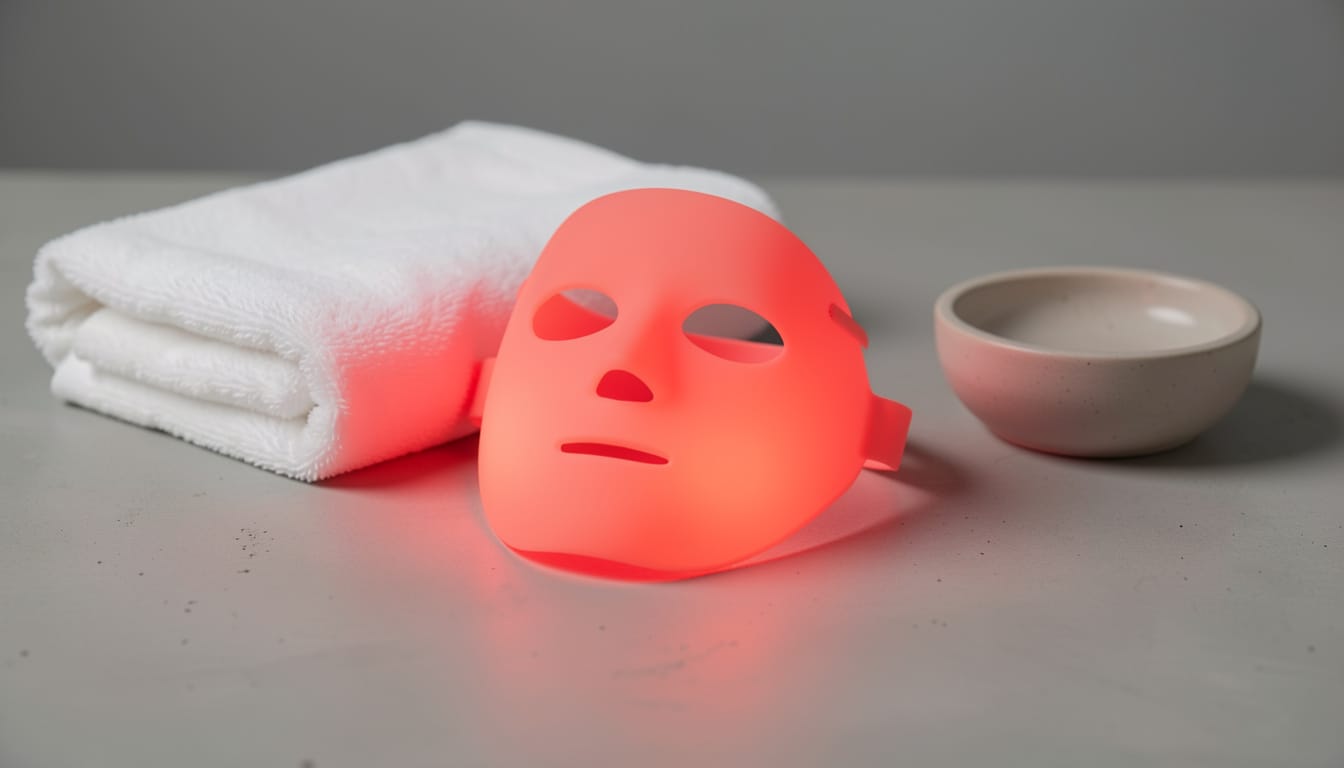
Best red light therapy masks on Amazon 2026 — entry, mid, and premium
Red light masks are the cheapest way to dose your face daily, but most Amazon listings hide the one number that matters: irradiance at the skin. Here are three picks across price tiers, ranked by what they actually deliver — not by LED count.
If you've read our red light therapy panels review, you already know the metric that matters: irradiance at treatment distance in mW/cm², not LED count or wattage. Masks make the distance question easy — they sit on your face — but they introduce two new problems most reviews ignore: wavelength accuracy (cheap LEDs drift off the 630/660/830/850 nm bands that have actual clinical data) and EMF leakage from the driver electronics resting against your skull.
This review picks three masks across price tiers and skips the marketing claims. The selection bar climbs with price: entry picks need to publish their wavelengths and offer a real return window — that's it, because most sub-$200 Amazon masks won't publish irradiance and waiting for one that does means recommending nothing. Mid and premium picks have to publish irradiance at the skin, full stop. The entry tier is a format-test buy; mid and premium are clinical investments and we hold them to a clinical standard.
At a glance
| Feature | GWOWLWF LED Face Mask | HigherDOSE Red Light Face Mask | CurrentBody Skin LED Mask Series 2 |
|---|---|---|---|
| Price tier | Entry | Mid | Premium |
| Wavelengths | 630 + 830 nm (plus 5 non-PBM colors) | 630 + 830 nm | 633 + 830 + 1072 nm |
| Irradiance @ skin | Not published | 50 mW/cm² (26 red + 24 NIR) | 30 mW/cm² |
| Session length | 10 min | 10 min | 10 min |
| LED count | Not stated | 132 (66 dual-core bulbs) | 236 |
| Rechargeable | ✓ | ✓ | ✓ |
| Best for | Trying a mask before spending more | Daily use with verified per-wavelength dosing | Verified specs, treating an existing skin concern |
What to look for
Wavelength accuracy. The clinical evidence sits on four bands: 630 nm and 660 nm for skin (collagen, fibroblast activity, surface inflammation) and 830 nm and 850 nm near-infrared for deeper tissue. Anything outside those windows — "640 nm," "680 nm," "808 nm" — is a sign the manufacturer is binning whatever LEDs they could source cheap. Masks that publish the actual peak wavelengths in the spec sheet are signaling they care; masks that only say "red and infrared" are not.
Irradiance at the skin, not at the LED. Panels are spec'd at 6 inches. Masks are flush against your face, so the only honest number is mW/cm² at the inner surface. The therapeutic dose for facial skin is 3–10 J/cm², which at 30 mW/cm² takes 100–330 seconds — i.e., a 10-minute session is roughly correct. Below 10 mW/cm², a 10-minute session is sub-therapeutic; above 100 mW/cm², you're risking heat irritation. Most Amazon masks land 15–60 mW/cm² at the skin, but many don't publish the number.
LED count is a vanity metric. A mask with 200 dim LEDs delivers less energy than one with 100 well-driven LEDs. Ignore the count; ask for the irradiance number.
EMF and driver placement. Cheap masks put the LED driver inside the shell, sometimes inches from your forehead. Higher-end masks route power through a tethered cable to an external driver. If you're sensitive to EMF or planning daily use over years, the external driver is the safer choice.
Eye protection. All bright LEDs near the eyes carry risk. Reputable masks include eye cutouts or supplied goggles. If a mask covers the eyes with active LEDs, only buy it if the manufacturer publishes specific photobiological-safety testing — most don't.
Refund window and warranty. LEDs degrade. A mask that loses 30% of its output by year two is common at the low end. A 1-year warranty is the bare minimum; 2–3 years signals the manufacturer expects the device to last.
Pros
- +Hands-free dosing — read or scroll while you treat
- +Flush-to-skin placement removes the distance-guessing problem panels have
- +Targets face and neck specifically — where users notice cosmetic results fastest
- +Cheaper entry point than full panels for skin-only goals
Cons
- −Most Amazon listings hide the irradiance and exact wavelength data
- −Cheap masks often use unverified LED bins drifting off therapeutic wavelengths
- −Coverage is limited to face — useless for muscle recovery or full-body PBM
- −LED degradation over 2–3 years is real; budget masks fade fastest
Verdict: A mask is the right buy if your goal is facial skin (collagen, tone, fine lines). For muscle recovery, joints, or full-body dosing, a panel is better dollar-for-dollar. At mid and premium tiers, skip any mask that won't publish its irradiance. At entry, settle for published wavelengths and a real return window — most sub-$200 masks don't list irradiance, and waiting for one that does means buying nothing.
Top picks
GWOWLWF LED Face Mask with Neck
A format-test buy at the entry price, not a clinical investment. The two wavelengths that matter — 630 nm red and 830 nm near-infrared — are published in the listing, which is more than most sub-$200 masks bother to do. Beyond those two, the mask runs five additional 'colors' (yellow, green, purple, white, blue) that have no PBM evidence behind them; treat the multi-color modes as cosmetic features, not therapeutic ones, and dose only with the red and NIR settings. Includes neck coverage, which is unusual at this tier, and runs cordless on a built-in rechargeable lithium battery with a 10-minute auto-off session. Honest gaps: irradiance at the skin is not published, the brand is an Amazon-generated name with no warranty track record, the LED count and eye-protection arrangement aren't stated on the listing, and the listing has only seven reviews so confidence in the long-term build quality is thin. Use the 30-day Amazon return window to confirm the mask delivers visible warmth and even coverage before committing — if it feels dim or patchy, return and step up to mid-tier.
- ✓Publishes the two wavelengths that matter — 630 nm red + 830 nm NIR
- ✓Includes neck coverage, unusual at this price tier
- ✓Cordless — built-in rechargeable lithium battery, 10-min auto-off
- ✓30-day Amazon return window — a real test-the-format option
- ✓Sub-$200 entry into the format without the worst LED-count gimmicks
HigherDOSE Red Light Face Mask
The workhorse pick — and the only mask in the lineup that publishes per-wavelength irradiance. 630 nm red at 26 mW/cm² and 830 nm NIR at 24 mW/cm² for a combined 50 mW/cm² at the inner mask surface, both numbers stated on HigherDose's own site and on the Amazon listing. That granularity matters: it lets you reason about red-band collagen dose and NIR-band deeper-tissue dose independently rather than guessing how a single combined number splits. FDA-cleared, USB-C rechargeable, fully cordless — no tethered controller and no driver pack to manage. Two honest caveats: the bands are 630/830, not the slightly more research-backed 660/850, and the warranty is one year vs CurrentBody's two. Both are minor, but flag them if you're optimizing for the deepest tissue penetration or longest service life.
- ✓Per-wavelength irradiance published — 26 mW/cm² @ 630 nm + 24 mW/cm² @ 830 nm
- ✓Both wavelengths inside the therapeutic window for skin and surface tissue
- ✓FDA-cleared, USB-C rechargeable, fully cordless
- ✓Reputable brand with track record in red light therapy products
CurrentBody Skin LED Light Therapy Mask: Series 2
The verified-specs pick. Three wavelengths — 633 nm red, 830 nm NIR, and 1072 nm deep NIR — across 236 LEDs, every one verified at the bin level by Veritace, the third-party LED-grading service. Published irradiance is 30 mW/cm² at the inner mask surface, which lands a 10-minute session at roughly 18 J/cm² — comfortably inside the therapeutic window for collagen induction without straying into heat-irritation territory. Flexible silicone shell with a multiway head strap means the LEDs sit consistently against the skin instead of standing off the cheekbones the way rigid masks do. Battery-powered controller on a tethered cable keeps the driver electronics off the skull. The right buy if you're treating an existing skin concern (melasma, post-procedure recovery, persistent redness) rather than a generic anti-aging routine — and the cheapest path to fully-published, third-party-verified specs we found on Amazon.
- ✓Three clinically-relevant wavelengths (633 / 830 / 1072 nm)
- ✓Published 30 mW/cm² irradiance at the inner mask surface
- ✓236 LEDs, each verified at the bin by Veritace
- ✓Tethered controller — low EMF exposure at the skull
- ✓Flexible silicone shell — LEDs stay flush across the face
The mask payback math
A typical dermatologist-administered LED facial in the US runs $60–$150 per session, with a recommended course of 8–12 sessions for visible results. At the low end, a 10-session course is $600. Here's how each tier compares assuming daily 10-minute home sessions:
- Entry mask (GWOWLWF, ~$160): pays back vs a 10-session in-clinic course in week 1. After 12 months of daily use, net savings vs the equivalent in-clinic cadence is roughly $1,760.
- Mid mask (HigherDOSE, ~$349): pays back in week 3. After 12 months, net savings is roughly $1,571. Per-wavelength irradiance data means you can dose deliberately rather than by guess.
- Premium mask (CurrentBody Series 2, ~$470): pays back in week 4. After 12 months, net savings is roughly $1,490, and the device has another 2+ years of useful life under warranty.
The math always favors a mask over recurring clinic visits. The real choice is how confident you are in what you're dosing — entry tier saves the most cash but gives you the least data on what's hitting your skin.
Mask vs panel — which to buy
Quick reference for choosing between formats if you only buy one:
- Skin-only goals (face, neck, tone, fine lines) → mask. Hands-free, flush-to-skin, no distance math.
- Muscle recovery, joint pain, full-body → panel. Masks don't reach those tissues meaningfully.
- Both, on a budget → start with a panel (see our panel review). You can dose your face by sitting close to the panel; you can't dose a sore shoulder with a mask.
- Both, no budget constraint → buy both. They're complementary, not redundant.
Frequently asked questions
How often should I use a red light mask?
Most clinical protocols use 3–5 sessions per week of 10 minutes each. Daily use is fine and not harmful, but the dose-response curve is biphasic — more is not always better. If you're not seeing results after 8 weeks at 5 sessions per week, the issue is irradiance, not frequency. Measure it or replace the mask.
Do red light masks actually work for wrinkles?
The evidence is strongest for collagen induction and skin texture, moderate for fine lines, and weaker for deep wrinkles. A 2014 study (Wunsch & Matuschka) showed measurable collagen density increase after 30 sessions at therapeutic doses. Masks that hit ~30 mW/cm² at the skin and use 630/660/830/850 nm wavelengths are the ones with a credible chance of replicating those results. Cheap masks below 10 mW/cm² will not.
Is it safe for the eyes?
Bright LEDs near the eyes always carry risk. Use the supplied goggles or eye cutouts; never stare into the LEDs even briefly. Pregnant users and people on photosensitizing medications (some antibiotics, retinoids, St John's Wort) should ask a doctor first. Children should not use these devices unsupervised.
Will a red light mask help with acne?
Blue light (~415 nm) is the wavelength with evidence for acne (kills Cutibacterium acnes). Most "red light masks" labeled for acne also include blue LEDs in dual-mode operation. Pure red/NIR helps with post-acne inflammation and scar remodeling, not active breakouts. Read the spec sheet for the exact wavelengths offered.
How long do the LEDs last?
Quality LEDs are rated for 30,000–50,000 hours. At 10 minutes a day, that's 50–80 years of theoretical life. In practice, driver failure and connector wear kill masks well before the LEDs do — usually 2–4 years on budget units, 5+ years on premium ones with external drivers. The warranty length is your best proxy for expected life.
Can I use a mask with skincare products?
Apply red-light treatment on clean, dry skin first, then apply serums and moisturizers. Some actives — retinoids, AHA/BHA, vitamin C — can become photosensitizing under bright LEDs. Use them at night and treat in the morning, or vice versa, but not at the same moment.
Mask or in-clinic LED facial?
Different problems, different solutions. A clinic delivers higher peak irradiance for shorter durations and offers professional skin assessment. A home mask delivers a smaller dose more frequently — and the cumulative weekly energy is what drives skin remodeling. For most cosmetic goals, a daily home mask outperforms occasional clinic visits over a 12-month window. For a specific dermatologic condition, see a dermatologist first.
Getting started
If you don't own any PBM device yet and want maximum flexibility, start with the red light panel review — a panel can dose your face plus everything below the neck. If your goal is specifically facial skin and you want a hands-free routine, a mask is the better-fit buy. For dosing protocol — irradiance, session length, and weekly cadence — the math in the panel review applies to masks too, just measured at the inner surface instead of at 6 inches.