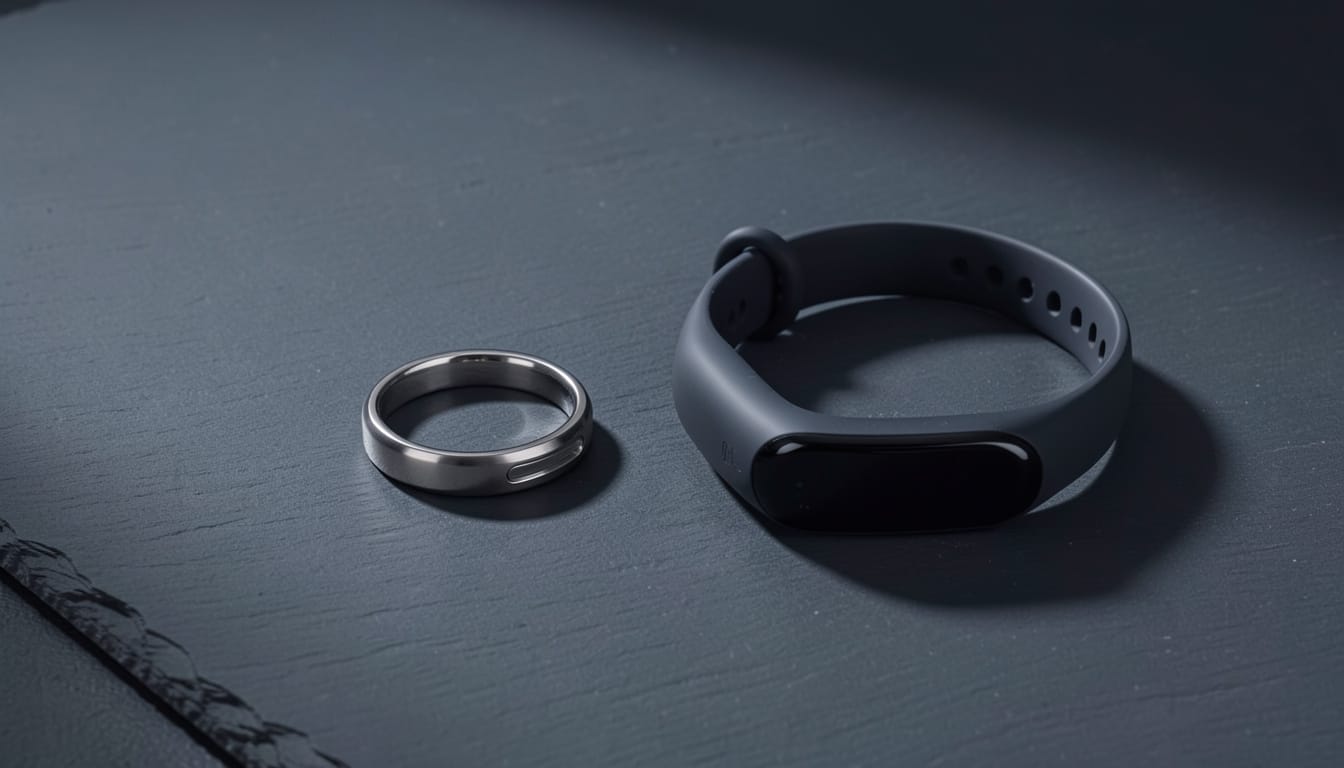
Best sleep trackers for HRV and recovery in 2026 — ranked by what the data actually tells you
Sleep tracking is only useful if the device measures what matters and presents it in a way you can act on. This review ranks the top options by HRV accuracy, sleep stage reliability, and the quality of recovery insights — not feature count.
The proliferation of consumer sleep trackers over the last five years has produced a useful problem: there are now enough devices with enough data to have meaningful conversations about which ones are actually measuring what they claim to measure, and which are producing plausible-looking numbers with limited physiological grounding.
This review focuses on two metrics that matter most in a recovery-oriented protocol: HRV (heart rate variability) as a measure of autonomic nervous system recovery, and slow-wave sleep duration as a measure of physical restoration. Devices that track 47 health metrics but cannot reliably measure these two are less useful for the longevity and performance audience than devices that measure fewer things accurately.
The form factor question — ring vs wrist band — is also addressed directly, because it affects measurement accuracy in ways that matter for the specific use case of overnight HRV tracking.
Why HRV is the metric that matters most
Heart rate variability — the variation in time between consecutive heartbeats — is the most validated non-invasive proxy for autonomic nervous system recovery available in consumer wearables. High overnight HRV indicates strong parasympathetic tone: the body is in restoration mode, inflammation is low, and the system is recovering from the previous day's stressors. Low HRV indicates ongoing sympathetic activation: incomplete recovery, elevated allostatic load, or physiological stress from illness, overtraining, alcohol, or poor sleep architecture.
The clinical literature on HRV spans decades of research in cardiology, sports science, and psychophysiology. The consumer wearable application is less precise than clinical ECG measurement — optical PPG sensors have known limitations — but the directional signal is reliable enough to be actionable for most users tracking trends over time.
The key distinction for wearable selection: HRV is most accurately measured overnight, during deep sleep, when parasympathetic tone is highest and movement artefact is minimal. Devices that measure HRV continuously during the day add noise without proportionally improving the signal. Overnight HRV, particularly in the first half of the night when slow-wave sleep dominates, is the measurement that tells you whether you recovered.
The ring vs wrist debate
Optical PPG sensors work by shining infrared light into tissue and detecting the reflected signal as blood volume changes with each heartbeat. The quality of this signal depends on consistent contact between the sensor and the skin surface.
The finger provides a significantly more consistent measurement environment than the wrist. Capillary density in the fingertip is high, the tissue is thin, and the ring form factor maintains sensor contact regardless of sleeping position. Wrist-based devices move during sleep, the sensor lifts off the skin as positions change, and the larger tissue volume produces more signal noise.
Independent validation studies comparing ring-based PPG to ECG gold standard have consistently found rings outperform wrist bands on HRV accuracy, with the Oura Ring in particular validated in multiple peer-reviewed publications. This does not mean wrist bands are useless — they produce actionable trend data — but it is a relevant specification for an audience building protocols around HRV as a primary recovery metric.
Top picks
Best overall: Oura Ring 4
The Oura Ring 4 is the most validated consumer sleep and HRV tracker available. Multiple independent studies have compared Oura's measurements to polysomnography (clinical sleep study) and ECG, with sleep stage accuracy and HRV precision consistently outperforming wrist-based competitors. The platform has also received the most longitudinal development — the app's readiness and sleep scores are based on your personal baseline rather than population averages, which produces more actionable daily guidance than static scoring systems.
Oura Ring 4
$349–$499
All-titanium smart ring. HRV validated against ECG in peer-reviewed literature. Sleep stage tracking, readiness scoring, cardiovascular age, stress tracking. Up to 8 days battery. $5.99/month membership required for full features. Available in silver, black, gold, stealth. Size range 4–15.
- ✓HRV accuracy validated against ECG in peer-reviewed studies — the most rigorous validation of any consumer ring
- ✓Personalised baseline scoring — readiness and sleep scores adapt to your physiology, not population averages
- ✓Platform maturity — continuous software updates have added cardiovascular age, stress resilience, and glucose integration
- ✓8-day battery life — no overnight charging gaps that break sleep data continuity
- ✓Waterproof to 100m — safe in cold plunges, saunas, and swimming
The subscription note: Oura requires a $5.99/month ($69.99/year) membership to access full app functionality. This is the primary legitimate criticism of the platform. Over two years, the total cost of Oura Ring 4 plus membership is approximately $490–$640 depending on colour, compared to a one-time purchase for subscription-free alternatives. Whether that premium is justified depends on how much you value the depth and quality of the platform's insights relative to raw metric tracking.
Sizing: Oura uses its own sizing system. Purchase the sizing kit before ordering the ring — it is the most common source of returns and the only meaningful friction in the buying process.
Best value: RingConn Gen 2
The RingConn Gen 2 is the strongest subscription-free alternative in the smart ring category. No monthly fee, full access to sleep tracking, HRV, stress monitoring, and activity insights from day one. The hardware is genuinely competitive: at 2mm thickness it is thinner than the Oura Ring 4, the 10–12 day battery life is the best in the category, and the titanium construction is comparable.
The differentiator that matters most for this audience: the Gen 2 is the only consumer smart ring with integrated sleep apnea monitoring, developed in collaboration with universities and hospitals. For users whose wearable data shows poor deep sleep or low HRV without an obvious explanation, undiagnosed sleep apnea is a significant possibility — and a smart ring that can flag this without a separate sleep study is a meaningful clinical addition.
RingConn Gen 2 Smart Ring
$199–$239
No subscription fee — full feature access included with purchase. Sleep apnea monitoring (AHI data). HRV, sleep stages, stress, heart rate. Ultra-thin 2mm design. 10–12 day battery life with 150-day charging case. Titanium. HSA/FSA eligible. IP68 waterproof. Sizes 6–14.
- ✓No subscription fee — the only meaningful cost is the upfront price
- ✓Sleep apnea monitoring — unique in the smart ring category, clinically validated
- ✓10–12 day battery life — best in class, reduces charging interruption to sleep data
- ✓Thinner and lighter than Oura Ring 4 — comfort advantage for continuous wear
- ✓HSA/FSA eligible
The honest trade-off: the RingConn app is more data-dense and less insight-driven than Oura's. If you want graphs and metrics to analyse yourself, RingConn delivers them. If you want the device to synthesise the data into a daily readiness score and tell you what to do with it, Oura's platform is more developed. Neither approach is wrong — it depends on how you interact with wearable data.
Whoop — why it's not in these picks
Whoop is the most common alternative mentioned alongside Oura and smart rings, and it deserves a direct explanation of why it does not appear in our top picks for the specific use case of sleep and HRV tracking.
Whoop is an excellent recovery tool for athletes who want continuous strain and recovery monitoring throughout the day. Its strain algorithm is the most sophisticated in the consumer wearable market for quantifying training load. For that use case, it is the best option available.
For sleep and HRV specifically: Whoop uses wrist-based PPG, which produces lower HRV accuracy than ring-based sensors. It also requires a monthly subscription ($30/month for the base plan) on top of the hardware cost, making it the most expensive option long-term. The sleep stage accuracy has been less consistently validated than Oura in the independent literature.
If you train at high volume and want the best training load and recovery integration, Whoop is worth considering. If sleep quality and HRV are your primary focus, either ring in this review measures what you care about more accurately for less ongoing cost.
What to look for in your data
Once you have a tracker, the metrics to monitor weekly rather than nightly:
7-night average HRV: nightly HRV fluctuates significantly based on single-session variables — alcohol, a hard workout, poor sleep position. The weekly average trend is the signal. A declining weekly average over two to three weeks indicates accumulating allostatic load that requires attention.
Deep sleep duration: track the weekly average, not individual nights. Baseline deep sleep varies significantly by age — younger adults typically spend 15–25% of sleep in deep sleep; this declines naturally with age. What matters is your personal trend and whether interventions (cold plunge timing, bedding, room temperature) produce measurable improvements.
Resting heart rate: elevation of 3–5+ BPM above your personal baseline is a reliable early signal of incoming illness, overtraining, or significant physiological stress. Often shows up 24–48 hours before subjective symptoms.
Sleep onset latency: longer than 20 minutes consistently suggests either elevated sympathetic tone at bedtime (caffeine timing, evening screen exposure, stress) or circadian misalignment. Cross-reference with your evening protocol.
The measurement feedback loop
The reason sleep trackers are worth the investment for a recovery-oriented protocol is not the metrics themselves — it is the feedback loop they create. When you implement an intervention (cold plunge timing, cooling bedding, alcohol elimination) and can see the effect in your data within one to two weeks, you have direct evidence of mechanism rather than subjective impression.
Both rings reviewed above integrate with the sleep temperature and cold plunge protocols covered in our other articles. The combination of a measured sleep environment, an evidence-based pre-sleep protocol, and a ring that quantifies the outcome is the complete sleep optimisation stack for someone who wants to know whether what they are doing is working.
As an Amazon Associate, LongevityGearLab earns from qualifying purchases. Prices and availability are accurate as of the date published and may change.