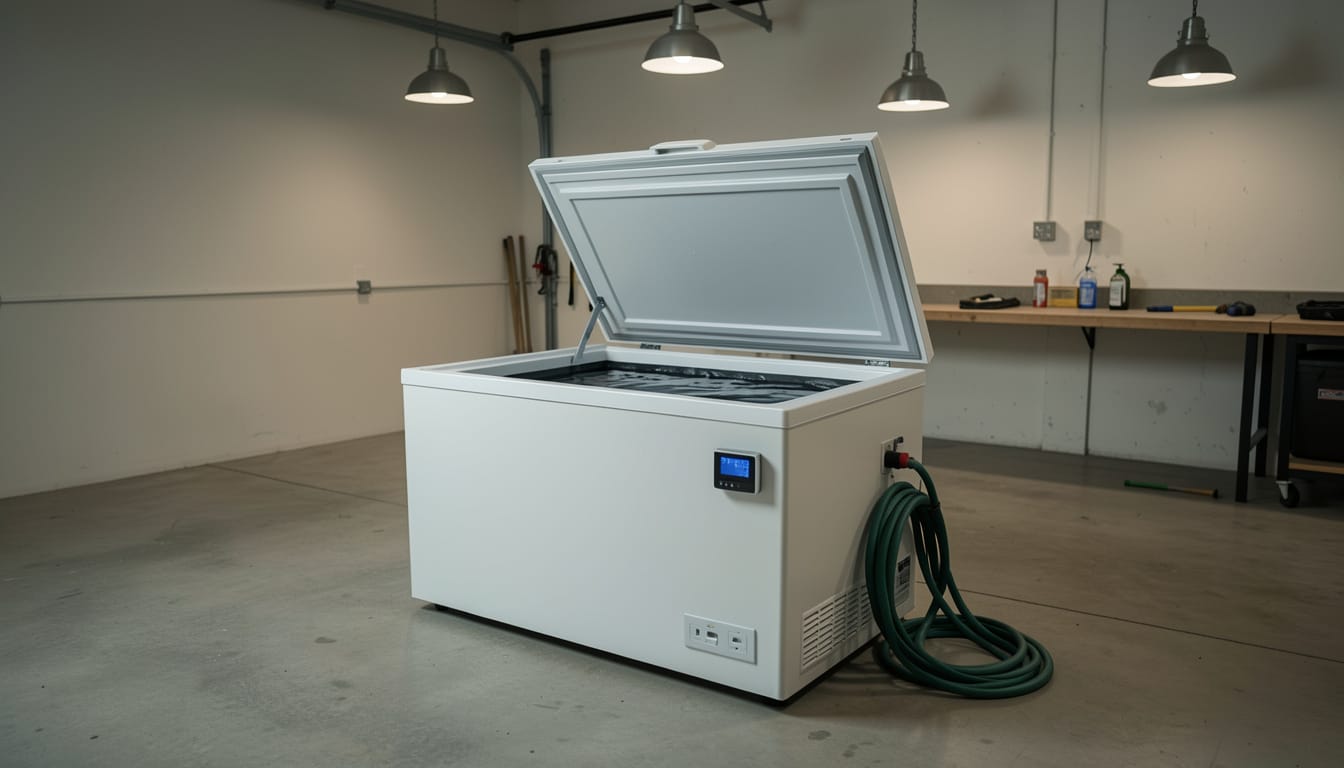
Best chest freezers for cold plunges 2026 — DIY ice baths that last a decade
A modified chest freezer is the cheapest cold plunge that actually works long-term. Here's how to pick one, what to look for, and the units we recommend on Amazon.
A purpose-built cold plunge from a wellness brand will run you $4,000–$8,000. A modified chest freezer does the same job for under $500, lasts longer, and is more temperature-stable because freezers are built for thermal mass. The catch is you have to be willing to spend an afternoon installing a pond liner and a drain plug.
This review ranks the best chest freezers on Amazon for cold-plunge conversion, focusing on the variables that actually matter — interior depth, lid weight, and thermostat range — not gimmicks.
What to look for
Interior depth: 27 inches minimum. You want to be submerged to the collarbone with knees bent. Residential chest freezers in the 7–10 cu ft range mostly cluster around 27–28" interior depth — workable for anyone up to ~5'10". Going up to 9 cu ft generally gets you more interior length (room to extend legs or share with a partner) but rarely more depth — they're built wider, not taller. Anyone over 6 feet who wants deep collarbone submersion should expect to compromise: knees up tight in any residential freezer.
Width and length: think about position. A 5–6 cu ft "compact" freezer is usually too narrow for adults to sit in comfortably. 7 cu ft is the practical minimum. 9 cu ft gives you room to sit cross-legged or extend your legs.
Lid weight matters surprisingly much. A spring-assisted lid is worth the upgrade — fighting a 30 lb chest freezer lid every morning gets old fast. Look for "manual defrost" models since auto-defrost cycles will fight your plunge temperature.
Temperature range. Most chest freezers go from -10°F up to ~32°F. To run a plunge in the 50–60°F range you'll need to either run the freezer briefly to chill water and unplug, OR add an external thermostat (Inkbird ITC-308 is the standard $35 option) that cycles power based on water temperature.
Pros
- +$300–$500 vs. $4,000+ for a purpose-built unit
- +Better insulation than purpose-built plunges (kept cold longer = less energy)
- +Lasts 10+ years; chest freezers are simple, durable appliances
- +External thermostat lets you set any temperature 35°F–60°F
Cons
- −Requires a pond liner or food-grade silicone — not a turn-key install
- −Drain plug install needs basic plumbing (or you'll be bailing every time)
- −Doesn't filter water — empty and refill every 1–2 weeks, or add ozone/chlorine
- −Heavy and large — needs garage, basement, or covered patio space
Verdict: If you have permanent space, a chest freezer is the best long-term value in cold plunges. The only reason to skip it is if you can't drill a drain hole in your floor and don't want to bail water by hand.
Top picks
Hamilton Beach 7 cu ft Chest Freezer (HBFRF713)
The sweet spot for solo use. Manual defrost design (the title's 'Easy Defrost Drain' is what you want — auto-defrost cycles fight your plunge temperature), adjustable thermostat, removable wire basket, and 27.17 inch interior depth. Hamilton Beach is a recognizable mainstream brand which makes parts and warranty support easy. Pair with an Inkbird ITC-308 thermostat for set-and-forget temperature control.
- ✓7 cu ft — fits one adult comfortably with knees bent
- ✓Manual defrost (won't fight your plunge temperature)
- ✓Mainstream brand with accessible parts and support
- ✓Standard 110V outlet
BLACK+DECKER BCF890E 8.9 cu ft Chest Freezer
Worth the extra footprint if you want room to extend your legs or share the plunge with a partner. 44.3 inches wide externally — significantly longer interior than a 7 cu ft unit. Manual defrost (Easy Access Drain), standard 120V outlet. Same approximate interior depth as the 7 cu ft Hamilton Beach, so this is about length, not deeper submersion.
- ✓44.3 inch exterior width — extra interior length
- ✓Manual defrost with easy-access drain
- ✓120V standard outlet
- ✓Comfortable for two-person use or leg extension
Inkbird ITC-308 digital temperature controller
The single most useful add-on. Plug the freezer into the Inkbird, dunk the probe in the water, set your target temp (e.g., 50°F), and the controller cycles freezer power on and off to maintain it. Without this, you're either over-chilling or constantly checking with a pool thermometer.
- ✓Set-and-forget temperature control
- ✓Works with any 110V freezer
- ✓Heating/cooling dual mode
Setup essentials
Beyond the freezer and thermostat, you'll need:
- Pond liner or food-grade silicone, $30–$60. Don't put your skin against bare freezer interior — it's not food-safe and small condensate channels at the base trap bacteria.
- Bulkhead drain fitting, $10–$20. Drilled into the side near the bottom, lets you drain through a hose instead of bailing.
- A pool thermometer for periodic verification of the Inkbird probe.
- Hydrogen peroxide or pool-grade chlorine if you don't want to drain weekly. A 1 ppm chlorine solution keeps the water clear for a month between full changes.
How to start
If you've never done cold exposure, don't run before you can walk: see How to dose cold exposure for the actual evidence-based protocol. The freezer is the easy part — knowing how long to sit in it without overdoing it is what separates "this works" from "this hurts and I quit after a week."
If garage space isn't an option, an inflatable plunge tub is the next best thing.