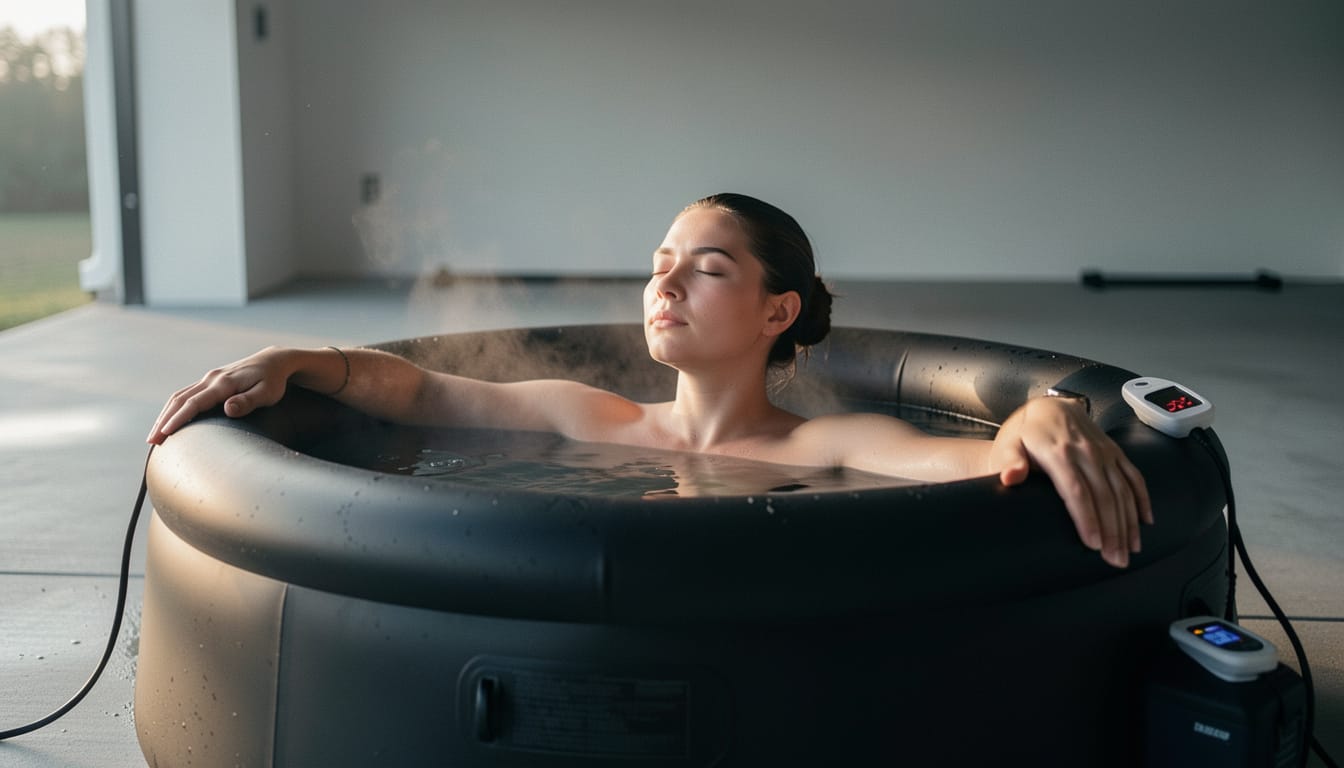
Cold plunge dosing guide: temperature, duration, and frequency explained
Most people either plunge too warm, too long, or too rarely. This guide covers the exact temperature ranges, session lengths, and weekly targets backed by peer-reviewed research — including the Søberg Protocol minimum effective dose.
Cold plunge content is dominated by two camps: people who say you need to be in ice water at 39°F for 20 minutes every morning, and people who say 30 seconds in lukewarm water is all you need. Both are wrong, and neither is reading the research.
The science on cold water immersion (CWI) has advanced considerably in the last five years. We now have reasonably clear data on what temperatures trigger what responses, how long exposure needs to be to produce specific outcomes, and how much weekly volume delivers measurable benefits without pushing into diminishing returns.
This guide covers all three variables — temperature, duration, and frequency — and gives you concrete protocols depending on your goals. If you want to know which inflatable cold plunge tub to buy before diving into the protocols, our best inflatable cold plunges 2026 review covers the full range from under $150 to under $1,000.
How cold water immersion actually works
Before the numbers make sense, it helps to understand the mechanism. Cold water immersion triggers a cascade of physiological responses that unfold in distinct phases.
In the first 30 seconds, cold receptors in the skin activate the sympathetic nervous system. Heart rate spikes, breathing shallows and accelerates, and blood vessels in the extremities constrict aggressively to redirect warm blood toward the core and vital organs. This is the cold shock response — the part that feels unpleasant and that most people want to cut short.
Between roughly one and three minutes, if you control your breathing and hold position, your body begins to adapt. The heart rate begins to settle, cortisol and norepinephrine levels are rising significantly, and you shift from survival mode into something more like controlled physiological stress.
Beyond three minutes, the adaptation phase continues. Brown adipose tissue (brown fat) is activated, mitochondrial density begins to respond to repeated cold exposure over time, and dopamine starts its prolonged elevation — one of the more durable neurochemical responses to cold, which can persist for hours after a session.
What you're trying to do with cold plunging is induce that second and third phase reliably, at the right dose, without spending so long in the water that you cross into hypothermia risk or systemic stress that interferes with recovery.
Temperature: the most important variable
Temperature determines how much stimulus you're applying to your system. It's also the variable most people get wrong — either defaulting to whatever comes out of the tap or assuming colder is always better.
The evidence-based ranges
Cold (50–59°F / 10–15°C) — the evidence-backed sweet spot for most practitioners. Research published in the European Journal of Applied Physiology demonstrated that immersion at 50°F for three minutes produces significant metabolic and recovery benefits. This range is cold enough to trigger vasoconstriction, norepinephrine release, and brown fat activation, without requiring extremely short session times. A landmark study in the Scandinavian Journal of Medicine & Science in Sports found that regular cold water immersion in this range improved immune function markers and reduced inflammation more effectively than warmer temperatures.
Very cold (39–50°F / 4–10°C) — appropriate for experienced practitioners with adapted cold tolerance. The physiological responses intensify, which means shorter sessions deliver equivalent stimulus. At 39°F, even experienced users should limit exposure to two to three minutes maximum. The benefits do not continue to scale indefinitely with lower temperatures — the incremental gain from 41°F versus 39°F is marginal, while the risk profile increases.
Cool (59–68°F / 15–20°C) — a starting range for beginners or for sessions focused on specific outcomes like pre-sleep core temperature reduction. At this range, you'll feel discomfort but won't trigger the full cold shock response. Useful for habit-building in the first two weeks, but insufficient for most of the metabolic benefits described in the research literature.
Pros
- +50–59°F is achievable with an inflatable tub and ice — no chiller required in cooler climates
- +This range triggers the full physiological response with manageable session lengths
- +Consistent sessions in this range produce measurable adaptation over 4–8 weeks
Cons
- −Achieving 39–50°F reliably requires a chiller — ice alone in a well-insulated tub will typically reach the upper end of this range at best
- −Beginners in the 39–50°F range often cut sessions short before the adaptation phase, missing the primary benefit window
- −Temperature accuracy matters — a tub you think is at 50°F may be 55°F or 58°F without measurement
Verdict: Buy a $15 thermometer and measure your actual water temperature before every session. Most people overestimate how cold their water is.
Temperature and goal matching
The right temperature depends on what you're trying to achieve.
For muscle recovery and inflammation reduction, the 50–59°F range is optimal. The vasoconstriction and subsequent vasodilation create the pumping mechanism that moves inflammatory markers out of muscle tissue. Going colder doesn't improve this outcome meaningfully.
For mental clarity and norepinephrine response, research by Dr. Susanna Søberg suggests temperatures in the 10–15°C range (50–59°F) combined with adequate duration are sufficient to produce the 250–530% norepinephrine increase documented in controlled studies. The mental sharpness most people report after cold plunging is primarily this norepinephrine spike.
For brown fat activation and metabolic adaptation, this is where lower temperatures and longer-term consistency matter more than any single session. Repeated cold exposure over weeks shifts your thermogenic capacity. Temperature needs to be cold enough to require active thermogenesis — roughly 59°F or below.
For sleep improvement, the mechanism is different. A cold plunge in the evening works by creating a rapid drop in core temperature, which triggers the parasympathetic nervous system and signals sleep onset. For this purpose, temperature precision matters less than timing — plunging 60 to 90 minutes before bed is more important than whether you're at 50°F or 55°F.
Duration: the minimum effective dose
The single most important finding in recent cold exposure research is that longer is not better past a threshold. This seems counterintuitive to most people new to cold plunging, who assume more time equals more benefit.
The data does not support that assumption.
The Søberg Protocol: 11 minutes per week
The most widely cited evidence-based framework comes from research by Susanna Søberg, PhD, published in Cell Metabolism in 2021. Her work identified 11 minutes of total cold water immersion per week as the minimum effective dose for producing the metabolic adaptations associated with cold therapy — specifically brown fat activation and improved insulin sensitivity.
Critically, these 11 minutes are spread across multiple sessions, not achieved in a single sitting. The research found that two to four sessions per week, totaling 11 minutes, produced the metabolic outcomes. Practitioners trying to hit 11 minutes in one session are misunderstanding both the research and the physiology.
An internal comparison published by IceBaths.com tracking two protocols over 90 days found 100% habit retention among practitioners following the Søberg threshold, compared to a 67% failure rate for those attempting maximum duration daily sessions. Regularity beats intensity.
Session length by experience level
Beginner (weeks 1–4): 30 seconds to 2 minutes per session at 55–60°F. The goal is habit formation and cold shock adaptation, not maximum dose. A beginner who gets out after 45 seconds has still trained the nervous system. Build gradually — increase by 15 to 30 seconds per session as the cold shock response becomes manageable.
Developing (weeks 4–12): 2–5 minutes per session at 50–55°F. This is where the primary physiological benefits begin. At three minutes in the 50–55°F range, you've triggered vasoconstriction, norepinephrine release, and are well into the adaptation phase. Most of the documented benefits in the research literature are achieved within this window.
Experienced: 5–10 minutes per session at 39–55°F, depending on temperature. This is not dramatically more beneficial than the 2–5 minute range — it primarily extends the duration of the norepinephrine response and provides longer brown fat activation signalling. Diminishing returns begin meaningfully after 10 minutes. Hypothermia risk increases past 15 minutes even for experienced practitioners at 50°F.
The 10-minute ceiling
Research consistently shows diminishing returns past 10–11 minutes at therapeutic temperatures. A useful mental model: cold plunging is a stimulus, not an endurance sport. You wouldn't hold a plank for 45 minutes expecting proportionally greater core strength gains than a two-minute hold. The stimulus triggers the adaptation; staying longer doesn't amplify it linearly.
There is no peer-reviewed evidence that 20-minute cold plunges provide proportionally greater benefit than 5–10 minute sessions. The people doing 20-minute sessions are usually doing it for psychological reasons — discipline, willpower training — which is a legitimate goal, but it's not what the metabolic research supports.
Frequency: how many sessions per week
The research literature is reasonably clear on frequency. The sweet spot for most goals is 3–5 sessions per week, with the minimum effective dose sitting at 2–3 sessions per week.
Why daily plunging is often counterproductive
Daily cold plunging sounds appealing and is popularised by high-profile practitioners. The problem is that cold exposure is a stressor, and all stressors require recovery. Treating cold plunging as a daily non-negotiable creates cumulative physiological stress that can interfere with sleep quality, hormonal rhythms, and training adaptation over time.
An exception: very short daily sessions (30–60 seconds) at moderate temperatures function more like a habit anchor and central nervous system activation tool than a physiological stressor, and are generally well-tolerated.
Frequency and training interaction
If you're strength training, the cold plunge frequency question intersects with workout timing in ways that matter. Cold exposure immediately post-workout blunts the inflammatory signalling that drives muscle hypertrophy. If building muscle is a primary goal, plunging immediately after resistance training 4–5 times per week will meaningfully impair that goal.
The practical protocol: on strength training days, either plunge before training (more than one hour prior) or wait at least two hours after. On cardio or recovery days, post-workout cold plunging is appropriate. This allows you to maintain a 3–4 session per week cold exposure volume without compromising training adaptation.
This topic deserves its own article — our full breakdown of cold plunge timing before and after workouts covers the research in detail.
Periodisation
Advanced practitioners who already periodise their training should also periodise cold exposure. During periods of high training load (competition blocks, progressive overload phases), reduce cold exposure frequency to 2 sessions per week focused on recovery. During deload weeks or off-season, frequency can increase to 4–5 sessions at slightly higher temperatures to build adaptation.
Practical protocols by goal
Protocol 1: General wellness and longevity (the Søberg minimum)
- Temperature: 50–59°F (10–15°C)
- Duration: 3 minutes per session
- Frequency: 3–4 sessions per week
- Total weekly dose: ~9–12 minutes
- Best time: Morning or early afternoon
- Notes: This protocol reliably meets the Søberg threshold. It's achievable with an inflatable tub and ice year-round in most climates. No chiller required.
Protocol 2: Athlete recovery
- Temperature: 50–55°F (10–13°C)
- Duration: 5 minutes per session
- Frequency: 3 sessions per week, on non-strength-training days or 2+ hours post-session
- Total weekly dose: ~15 minutes
- Best time: Post-cardio or on rest days
- Notes: Targets DOMS reduction and faster return to training. Avoids blunting hypertrophy signalling on strength days.
Protocol 3: Mental performance and energy
- Temperature: 50–59°F (10–15°C)
- Duration: 2–3 minutes
- Frequency: 4–5 sessions per week
- Total weekly dose: ~10–15 minutes
- Best time: Morning, before focused work
- Notes: Optimised for the norepinephrine spike and dopamine elevation. Shorter, more frequent sessions better serve this goal than longer, less frequent ones. Do not use within 4 hours of intended sleep.
Protocol 4: Beginner — first 30 days
- Week 1–2: Cold shower only or cool-water tub at 60–65°F, 30–60 seconds, daily if possible
- Week 3–4: Tub at 55–60°F, 1–2 minutes, 4 sessions per week
- Week 5 onward: Transition to Protocol 1, adjusting temperature down by 2–3°F per week until reaching 50–55°F
- Notes: The first two weeks are about training the cold shock response — specifically, learning to control breathing on first contact with cold water. This skill unlocks the ability to stay in long enough to reach the adaptation phase.
What to do after you get out
Post-plunge behaviour is underrated and often done wrong.
Avoid hot showers for 15–20 minutes. The post-plunge period is when thermogenesis peaks — your body is generating heat internally to restore core temperature. This is brown fat activation in action. Jumping into a hot shower immediately terminates this process. The shivering and cold sensation you feel after exiting is beneficial, not something to eliminate as quickly as possible.
Rewarm through movement. Walking, light calisthenics, or simply towelling off and moving around achieves the same warming effect as a hot shower without cutting off the thermogenic response. Horse stance — standing with feet wide, knees slightly bent — is recommended by some practitioners as a controlled rewarming posture.
Timing of eating. There is no strong evidence that eating immediately before or after cold plunging is harmful for most people, though some practitioners prefer to plunge fasted in the morning for the norepinephrine and mental clarity effects.
Track your actual dose. A $15 waterproof timer and thermometer are the most useful accessories you can buy. Without measuring temperature, most people have no idea how cold their water actually is. Without timing sessions, the natural tendency under cold stress is to underestimate elapsed time and exit early.
Safety considerations
Cold water immersion is contraindicated for people with cardiovascular disease, arrhythmias including atrial fibrillation, uncontrolled hypertension, Raynaud's phenomenon, peripheral neuropathy, or uncontrolled diabetes. If you are pregnant, consult a clinician before starting.
Never plunge alone in your first several sessions. The cold shock response can cause hyperventilation and involuntary gasping — both manageable with experience, but unpredictable in beginners. Have someone nearby.
Exit immediately and rewarm if you experience dizziness, confusion, chest pain, or involuntary muscle cramping. These are signs of excessive cold stress or early hypothermia.
Tub recommendations by protocol
For Protocols 1–3, a chiller-compatible inflatable tub is the most practical home setup. It lets you dial in precise temperatures rather than relying on ice additions and guesswork.
For beginners starting Protocol 4, a budget inflatable tub used with ice is entirely sufficient — and a sensible way to validate that cold plunging fits your routine before investing in a chiller setup. Our best inflatable cold plunges 2026 guide covers verified options at the under-$150, under-$500, and under-$1,000 price points, with notes on which tubs are chiller-compatible for when you're ready to upgrade.
View The Cold Pod on Amazon (under $150)
As an Amazon Associate, LongevityGearLab earns from qualifying purchases. Prices and availability are accurate as of the date published and may change.