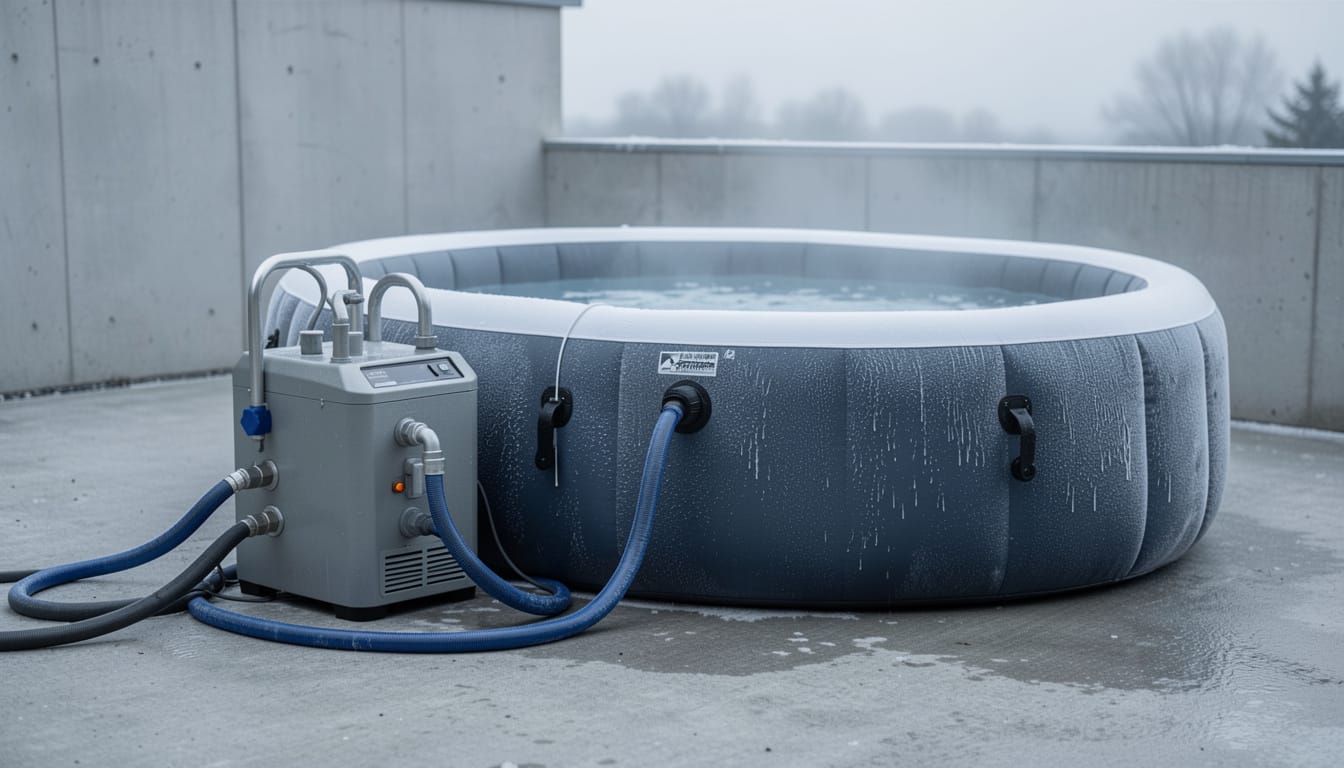
Do you need a cold plunge chiller? Ice vs chiller — the honest cost breakdown
Ice seems cheaper than a chiller until you do the maths. This breakdown covers the real ongoing cost of ice, what a chiller costs to run, which inflatable tubs are chiller-compatible, and at what usage frequency the investment calculus flips.
The most common question from people who have been cold plunging with ice for two to three months is some version of: "at what point does a chiller make more sense?"
It is a sensible question, and the answer is more specific than most buying guides suggest. Whether a chiller is worth the investment depends on three variables: how frequently you plunge, how much ice costs where you live, and what tub you already have or are planning to buy. This breakdown gives you the numbers to answer it for your specific situation rather than a general recommendation that may not apply to you.
The real cost of ice
Ice seems cheap until you use it consistently. A single cold plunge session using ice typically requires:
For a standard 85–100 gallon inflatable tub:
- Starting water temperature from tap: 55–65°F depending on climate and season
- Target temperature: 50–55°F for a standard protocol session
- Ice required to drop temperature by 10°F in 85 gallons: approximately 20–25 lbs
- Ice required to drop 15°F: approximately 30–40 lbs
A 20 lb bag of ice from a petrol station or supermarket typically costs $2–$5 depending on location. Buying in bulk from a ice supply company reduces this to $1–$2 per 20 lbs.
The maths at different usage frequencies:
| Sessions per week | Ice per session | Weekly ice cost (retail) | Annual ice cost |
|---|---|---|---|
| 2 sessions | 25 lbs | $5–$12 | $260–$624 |
| 3 sessions | 25 lbs | $7.50–$18 | $390–$936 |
| 5 sessions | 25 lbs | $12.50–$30 | $650–$1,560 |
These figures assume you are changing the water between sessions, which you should be for hygiene reasons. If you are treating the water and reusing it across sessions, the ice cost drops significantly — you are only topping up temperature rather than starting from tap temperature each time.
The climate adjustment: in cold climates where tap water runs at 45–50°F, you may need no ice at all for several months of the year, reducing the annual cost considerably. In warm climates where tap water is 65–70°F, ice requirements are higher and the chiller case strengthens faster.
What a chiller actually costs
A cold plunge chiller is a refrigeration unit that connects to your tub via inlet and outlet hoses and continuously circulates cooled water. Unlike ice — which is a one-time temperature drop followed by gradual warming — a chiller maintains a set temperature indefinitely.
Purchase cost: purpose-built cold plunge chillers on Amazon range from approximately $400 for basic units to $1,500+ for high-capacity units with WiFi control and filtration. The most relevant range for inflatable tub owners is $400–$800 — units powerful enough to cool 85–150 gallons to 50°F in a reasonable time frame.
Running cost: a typical 1HP cold plunge chiller draws approximately 800–1,200 watts when actively cooling. Once at temperature, it cycles on and off to maintain the set point — typically drawing 200–400 watts on average. At the US average electricity rate of approximately $0.16 per kWh:
| Usage | Average draw | Daily running cost | Annual running cost |
|---|---|---|---|
| Cooling to temp (2hr) | 1,000W | $0.32 per session | — |
| Maintaining temp (24hr) | 300W average | $1.15/day | $420/year |
| Session use only (not stored cold) | 1,000W × 2hr | $0.32 per session | $33–$83 (2–5x/week) |
The key decision: do you keep the water cold continuously, or do you cool it before each session and let it warm in between?
Continuous cooling is more convenient but costs ~$420/year in electricity. This is offset by eliminating the need to wait for the water to cool before each session. It also allows water treatment to work effectively — maintaining water quality in a continuously circulated, temperature-controlled system is straightforward.
Session-only cooling reduces electricity cost to under $100/year but requires pre-cooling time of 1–3 hours before each session, depending on starting water temperature and chiller capacity.
The break-even calculation
At retail ice prices ($3–$5 per 20 lb bag, 25 lbs per session):
| Sessions per week | Annual ice cost | Chiller purchase ($600) + annual electricity ($100 session-only) | Break-even year |
|---|---|---|---|
| 2 sessions | ~$390–$780 | $700 year 1, $100 thereafter | Year 1–2 |
| 3 sessions | ~$585–$1,170 | $700 year 1, $100 thereafter | Year 1 |
| 5 sessions | ~$975–$1,950 | $700 year 1, $100 thereafter | Year 1 |
At 3 or more sessions per week, a mid-range chiller pays for itself within the first year at retail ice prices. At 2 sessions per week, break-even occurs in year one or two depending on your local ice cost. Beyond year one, the ongoing electricity cost of session-only chiller use is dramatically lower than retail ice.
The calculation shifts further toward the chiller if:
- You buy a chiller with an integrated filtration system, eliminating water treatment costs
- You are in a warm climate where ice requirements per session are higher
- You value the ability to set and maintain a precise temperature consistently
The calculation shifts toward ice if:
- You plunge less than twice per week
- You have access to bulk ice at significantly below retail price
- You are still testing whether cold plunging fits your routine long-term
Which tubs are chiller-compatible
This is the specification most buyers overlook when purchasing an inflatable tub, and it matters significantly if there is any chance you will want a chiller in the future.
Chiller compatibility requires two things: inlet and outlet ports sized to accept standard chiller hose fittings (typically 0.5–0.75 inch), and a tub construction robust enough to support continuous water circulation without leaking at the fittings.
The Cold Pod (ASIN: B0BTSRJ4MY) — the most widely purchased entry-level inflatable. The base model does not have dedicated chiller ports. Some users fit aftermarket adapters through the drain fitting, but this is a workaround rather than a designed feature. If you are likely to add a chiller, this tub is the wrong choice. Buy it if you want an ice-only setup that you can test the practice with before committing to a larger investment.
The Cold Pod Inflatable Ice Bath
$90–$130
85-gallon inflatable, quadruple-layer insulation, includes lid. The most widely purchased entry-level cold plunge on Amazon. Ice-only setup — no dedicated chiller ports. The right choice for testing the practice before committing to a chiller investment.
- ✓Lowest entry cost to dedicated cold plunge hardware
- ✓Insulated lid maintains temperature between top-ups
- ✓Proven design with large review base
AKSPORT 151-Gallon (ASIN: B0DWMYGTT1) — the mid-tier recommendation from our inflatable cold plunge buying guide. This tub has dedicated inlet and outlet ports designed for chiller connection. The 151-gallon capacity is better suited to chiller use — larger volume maintains temperature stability better and requires less chiller cycling to hold temperature. The reinforced hard inner wall construction handles continuous circulation better than pure inflatable designs.
AKSPORT 151-Gallon Inflatable Cold Plunge
$150–$300
151-gallon capacity, chiller-compatible inlet/outlet ports, reinforced hard inner wall, non-slip base. The step-up choice for anyone planning to add a chiller now or later. Larger volume = better temperature stability and less chiller workload.
- ✓Dedicated chiller inlet/outlet ports — designed for chiller connection
- ✓151-gallon capacity maintains temperature stability better than 85-gallon alternatives
- ✓Hard inner wall handles continuous water circulation without stress on seams
- ✓Priced to buy now and add a chiller later without replacing the tub
What to look for in a chiller
If you have decided the chiller makes sense for your usage frequency, the key specifications to evaluate:
Cooling capacity (BTU or HP): for an 85-gallon tub, a 0.5HP chiller is the minimum; 1HP is recommended. For 150 gallons, 1HP minimum; 1.5HP for faster cool-down times. Undersized chillers run continuously without reaching set temperature — consuming more electricity without delivering the result.
Filtration: some chillers include a built-in UV or ozone filter that sterilises the water during circulation. This eliminates the need for separate water treatment chemicals and is worth the price premium for users who keep their water cold continuously. Without filtration, you need to treat the water manually with bromine or hydrogen peroxide to prevent bacterial growth.
Noise level: chillers run a compressor, which produces noise comparable to a refrigerator or small air conditioning unit. Check the decibel rating and consider placement — a chiller running in a garage or outdoors is less of an issue than one on a balcony.
WiFi control: available on mid-to-premium chillers, allowing you to pre-cool before a session via an app rather than planning hours in advance. Worth the premium for session-only cooling protocols where timing matters.
The practical decision
Buy the AKSPORT and a chiller now if you are already doing three or more sessions per week with ice and the annual ice cost exceeds $500. The break-even is year one.
Buy the Cold Pod first, add a chiller-compatible tub later if you are new to cold plunging and want to validate the practice before committing to a larger setup. The Cold Pod is the lowest-friction way to start. If you are still plunging consistently after three months, replace it with a chiller-compatible tub and add the chiller.
Stick with ice indefinitely if you plunge once or twice a week, have access to bulk ice, or are in a cold climate where tap water handles most of the temperature work. The break-even timeline does not favour a chiller investment at that usage frequency.
The honest version of this question is: how long have you actually been doing this, and how likely are you to still be doing it in twelve months? Cold plunging has a meaningful dropout rate in the first sixty days. A chiller purchased before the habit is established is an expensive piece of equipment for someone who decides the practice is not for them after month two.
For the protocol that builds the habit reliably before you make the equipment investment, see our cold plunge beginner's guide.