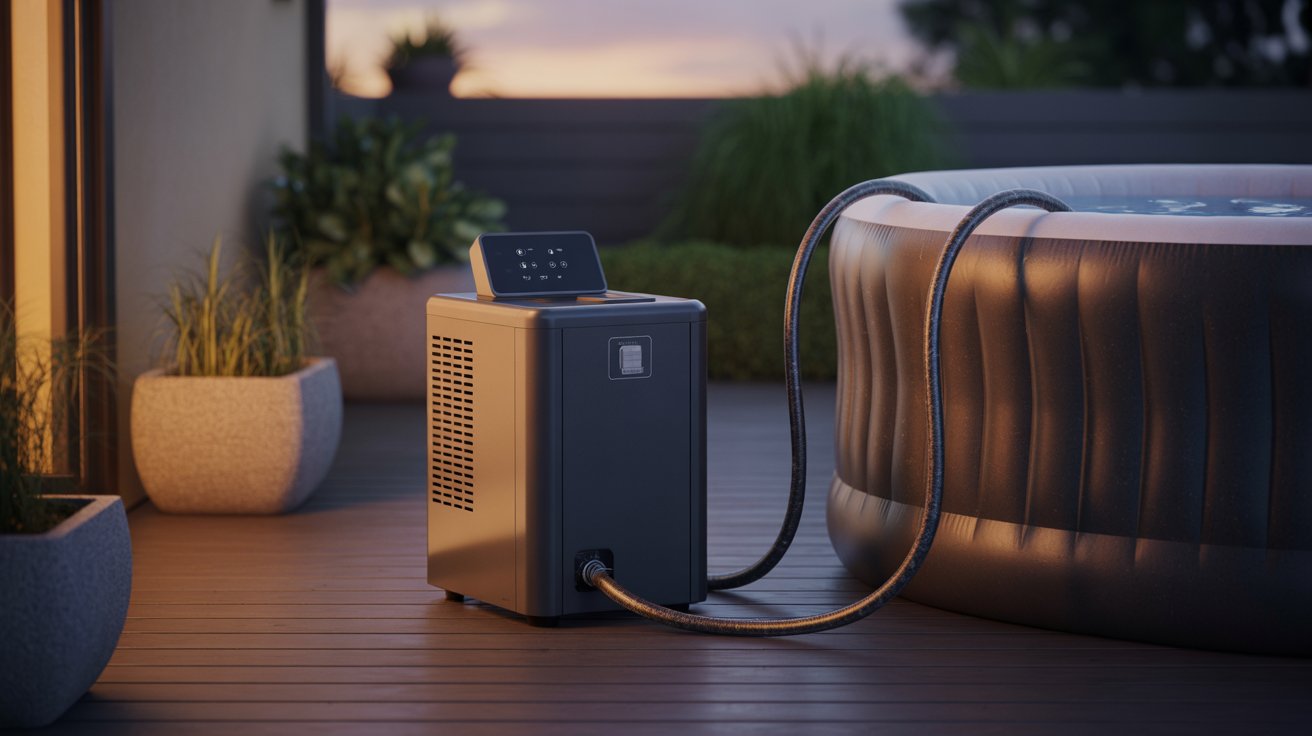
Best cold plunge chillers on Amazon 2026 — entry, mid, and premium
Once you've used a cold plunge for more than six weeks, ice gets expensive fast. A water chiller pays for itself in under two months and runs for years. Here are three Amazon picks across price tiers — including the hydroponic-chiller hack that saves you 30%.
If you've been using an inflatable plunge or chest freezer for more than a few weeks, you've already done the math on ice. A 90-gallon tub takes ~50 lb of ice to drop from 70°F to 50°F, supermarket bags are ~$3 per 7 lb, and three sessions a week works out to roughly $240 a month in ice. After two months, you've spent more than the price of a chiller you could've owned outright.
This review picks three water chillers across price tiers, and gets into a piece of the market most reviews skip: most "cold plunge chillers" sold on Amazon are rebranded hydroponic water chillers — same compressors, same flow rates, often the same factories. Buying the hydroponic version directly saves 30–40% with no functional difference for plunge use.
At a glance
| Feature | Active Aqua 1/4 HP | EcoPlus 1/2 HP | EcoPlus 1 HP |
|---|---|---|---|
| Price tier | Entry | Mid | Premium |
| Horsepower | 1/4 HP | 1/2 HP | 1 HP |
| Tub volume | 40–92 gal | 80–130 gal | 130–200 gal |
| Time to chill (70→50°F) | ~3 hr | ~90 min | ~45 min |
| Heating function | ✗ | ✗ | ✗ |
| Smart control | ✗ | Remote temp controller | Remote temp controller |
| Best for | Small tubs, occasional use | Daily users, 80–130 gal tubs | Large tubs, daily heavy use |
What to look for
Horsepower vs tub volume. The single most-confused spec. Higher HP doesn't mean colder water — it means faster chilling. A 1/4 HP unit on a 150-gallon tub will eventually reach your target temperature; it'll just take 6+ hours instead of 90 minutes. Match HP to volume and to how often you'll use it. Daily users want fast recovery between sessions; weekly users can run a smaller chiller overnight.
Flow rate. Listed in gallons per hour (GPH). The chiller circulates water from your tub through its evaporator and back. Lower flow = uneven cooling and warm spots. For a 90-gallon tub, look for a chiller that turns over the full volume in under an hour — roughly 100 GPH or higher.
Inlet / outlet sizing. Most consumer chillers use 1/2-inch or 5/8-inch barbed fittings. Your tub's chiller-ready ports (if it has them) need to match, or you need adapters. The AKSPORT and OSMOPLUNGE plunges from our inflatable plunge review use standard sizing, so most chillers connect without fuss.
Heating function. Some chillers reverse-cycle to heat water as well as cool it. Useful if you want contrast therapy (cold plunge then warm water) without a separate heater, but adds 30–50% to the price. Skip it unless you'll actually use it.
Noise. Compressor chillers run between 45 and 65 dB. Anything above 55 dB is too loud for indoor living spaces. Garage or outdoor placement is more forgiving. Manufacturer noise specs are unreliable — check recent reviews for honest numbers.
Hydroponic vs "cold plunge" branding. This is the budget hack. Hydroponic water chillers (Active Aqua, EcoPlus, Hailea) are designed to keep nutrient solution cold for indoor cannabis and aquaculture grows. They have the same compressors, flow rates, and temperature ranges as branded cold plunge chillers — and typically cost 30–40% less for equivalent specs. The only meaningful difference is cosmetic packaging and a "designed for ice baths" label.
Pros
- +Pays back in under 8 weeks of regular use vs supermarket ice
- +Holds target temperature indefinitely — chill once, plunge for days
- +Eliminates the daily ice run and the freezer space it eats
- +Hydroponic chillers offer 30–40% savings for equivalent specs
Cons
- −$300–$1,500 upfront depending on tier
- −Adds plumbing complexity (pump, hoses, fittings, sanitization)
- −Adds 30–80W of standby power draw
- −Compressor noise — most aren't suitable for indoor living spaces
Verdict: Worth it for anyone plunging 3+ times a week. Skip for casual or testing use — ice is fine for the first 6 weeks. The hydroponic chiller route saves you the most money for equivalent performance.
Top picks
Active Aqua Hydroponic Water Chiller, 1/4 HP
The cheapest credible chiller for cold plunge use. Rated for 40–92 gallon reservoirs, which lines up with the Cold Pod 85 and most entry-level inflatable tubs. Brings a 70°F tub to 50°F in roughly three hours — slow enough that you set it before bed, fast enough for daily plunging. Two features matter: a pure titanium evaporator that resists corrosion in chlorinated or sanitized water, and a boost function for faster initial pulldown. Mixed reviews mostly come from users running it on tubs above its rated capacity — sized correctly, it does the job.
- ✓Lowest price for a real compressor chiller in this HP class
- ✓Pure titanium evaporator — corrosion-resistant in sanitized plunge water
- ✓Boost function for faster initial cooldown
- ✓Rated for 40–92 gal — covers the Cold Pod 85 and most entry tubs
EcoPlus Commercial Grade Water Chiller, 1/2 HP
The workhorse pick. 1/2 HP handles cold plunge tubs in the 80–130 gallon range and chills 70°F water to 50°F in roughly 90 minutes — fast enough to plunge same-day if you set it before lunch. Pure titanium heat exchanger and anti-corrosive aluminum radiator handle sanitized plunge water without degrading. The standout feature is the remote temperature controller with a 30-foot cord: park the chiller out of earshot in the garage and check the water temp from a panel near the tub. For tubs at the AKSPORT's 151-gallon size or above, step up to the 1 HP premium pick instead — this unit is at its limit there.
- ✓Right HP for the most common cold-plunge tub sizes (80–130 gal)
- ✓Pure titanium heat exchanger — corrosion-resistant in sanitized water
- ✓Remote temperature controller with 30 ft cord — quiet placement, easy monitoring
- ✓Roughly 90 minutes from room temp to plunge temp
EcoPlus Commercial Grade Water Chiller, 1 HP
The biggest-tub, daily-heavy-use pick. 1 HP brings a 150-gallon tub from 70°F to plunge temp in roughly 45 minutes and recovers fast between sessions, which matters if multiple people in the household use the tub each day. Same proven hardware as the EcoPlus 1/2 HP — pure titanium heat exchanger, Japanese compressor, 30-foot remote temperature controller — scaled up for AKSPORT-sized inflatable tubs and chest-freezer plunge builds with serious water volume. No WiFi, no heating function. At ~$1,499 on Amazon, this is where the hydroponic-vs-branded math gets close: branded 1 HP cold plunge chillers run $1,700+ on Amazon, but the same brands are sometimes $1,190–$1,300 direct from the manufacturer's own site. Worth comparing both before buying.
- ✓1 HP / 5,115 BTU — fastest chill in the lineup, scales to 130–200 gal tubs
- ✓Pure titanium heat exchanger and Japanese compressor — built for sustained daily use
- ✓30 ft remote temperature controller — quiet placement, easy monitoring
- ✓Cheaper than branded 1 HP Amazon listings ($1,700+), though direct-from-manufacturer cold plunge brands sometimes match or beat its price
The chiller payback math
The three sessions a week, 90-gallon tub, $3-per-bag-of-ice scenario costs roughly $240/month in ice. Here's how each chiller pays back at that usage level:
- Active Aqua 1/4 HP (~$280): pays back in 5 weeks. After 12 months, net savings vs ice is roughly $2,600.
- EcoPlus 1/2 HP (~$520): pays back in 9 weeks. After 12 months, net savings is roughly $2,350.
- EcoPlus 1 HP (~$1,499): pays back in 27 weeks. After 12 months, net savings is roughly $1,381.
The entry tier wins on raw payback time, but the mid-tier wins on lifetime value because it handles the most common tub sizes and holds temperature steady. The premium tier only makes sense if you have a 130-gallon-plus tub or share it between multiple daily users — at that scale, 1/2 HP would be working at its limit and the extra capacity earns its keep.
Power draw across all three is 30–80W on standby, climbing to 400–1200W when actively chilling. At average US electricity rates (~$0.16/kWh), monthly running cost lands between $4 and $15 depending on tier and how often you let the water warm up between sessions.
Sizing the chiller to your tub
Quick reference for matching HP to tub volume, assuming you want target temperature reached in under three hours starting from 70°F:
- Up to 60 gallons — 1/10 HP works, 1/4 HP is fast
- 60–100 gallons — 1/4 HP minimum, 1/2 HP comfortable
- 100–150 gallons — 1/2 HP minimum
- 150–200 gallons — 1 HP, especially for daily use
If you're using a chest freezer build (insulation is much better than inflatable), you can size down one tier — the freezer holds cold so well that the chiller mostly just removes the heat your body adds during sessions.
Frequently asked questions
Is a hydroponic chiller really the same as a cold plunge chiller?
For practical cold plunge use, yes. The compressors, flow rates, temperature ranges, and build quality are equivalent in the same HP class. Branded cold plunge chillers add cosmetic differences — better cable management, prettier housings, "designed for ice baths" marketing — but the cooling hardware is the same. The one real difference: some branded units include a heating function for contrast therapy, which most hydroponic units lack.
Do I need a separate pump?
Sometimes. Higher-end chillers include a built-in circulation pump; entry and mid-tier hydroponic chillers usually require a separate submersible pump (~$30–$60). Check the listing carefully. The pump's job is to push tub water through the chiller's evaporator coil and back. Without circulation, you get warm spots and the chiller short-cycles.
How loud are cold plunge chillers?
Compressor chillers run between 45 and 65 dB. Hydroponic chillers tend to be 48–55 dB. Premium cold plunge units with sound dampening get under 49 dB. None are silent. Indoor living-space placement requires the quietest tier; garage, basement, or outdoor placement is more forgiving.
Can a chiller heat water too?
Only some can. Reversible heat-pump chillers cycle the refrigerant in the opposite direction to heat the water — the same technology as a heat pump for home HVAC. They cost 30–50% more than cooling-only units. Worth it if you want contrast therapy (e.g., 50°F cold plunge then 105°F warm soak) without buying a separate heater. Most hydroponic chillers are cooling-only.
Will a chiller work with any tub?
Functionally yes, but plumbing matters. Tubs with built-in chiller-ready ports (the AKSPORT and OSMOPLUNGE inflatable plunges, most chest freezer builds) are plug-and-play. Tubs without ports need a "drop in" loop — a submersible pump and two hoses lowered into the water. Drop-in setups work fine but look messier and are slightly less efficient.
How long do cold plunge chillers last?
Compressor chillers, when sized correctly and not overworked, run reliably for 5–10 years. Undersized chillers running near capacity wear out faster — another reason to err one HP tier higher if you're plunging daily. The chiller will outlast the tub, which is one reason to spend more on the chiller and less on the tub.
Chiller or chest freezer build?
Different problems, different solutions. A chiller cools the water in your existing tub. A chest freezer build replaces the tub itself with an insulated freezer body that holds cold extremely well with very little active cooling. Freezer builds are cheapest long-term if you have permanent space; chillers paired with an inflatable tub are best if you need to pack the setup away.
Getting started
If you don't have a tub yet, start with the inflatable cold plunge review — pick a tub with chiller-ready ports so you can add this chiller later without re-buying. If protocol matters more than gear, see how to dose cold exposure and the beginner's 30-day protocol.