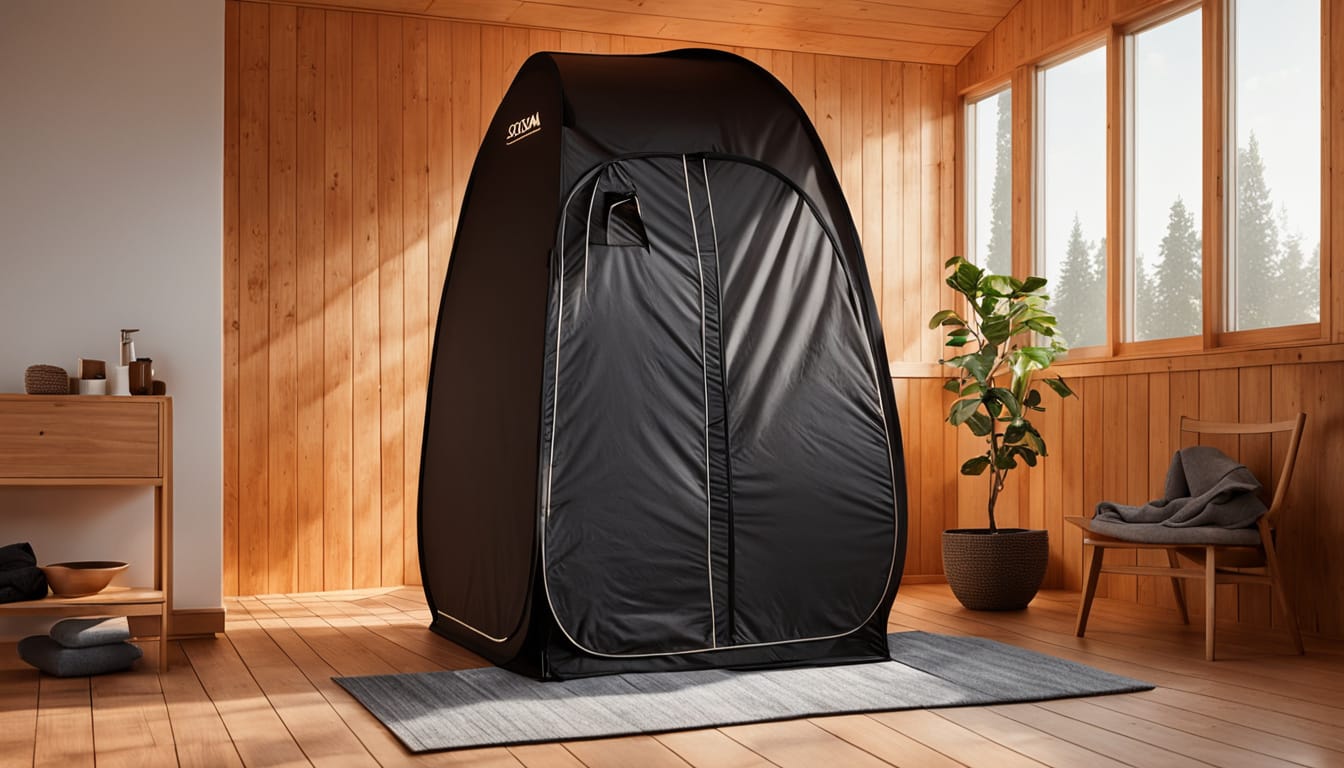
Best portable sauna tents 2026 — ranked for contrast therapy, temperature, and build quality
Portable sauna tents offer one key advantage over blankets for longevity and recovery protocols: the seated position allows fast transitions to a cold plunge. This review covers the specifications that matter for that use case — and the honest limitation that no portable tent reaches Finnish sauna temperatures.
In the contrast therapy guide published on this site, portable sauna tents were noted as better suited to hot-cold cycling than infrared blankets. The reason is practical: a tent's seated position allows you to stand, exit, and transition to a cold plunge in under 15 seconds. A blanket requires unzipping, standing, and orienting yourself before you can move — by which point 30–60 seconds of your post-sauna core temperature elevation has been spent.
For practitioners building a contrast therapy protocol at home, that transition speed matters. The vascular pumping mechanism that makes contrast therapy physiologically distinct from either modality alone depends partly on applying cold stimulus while core temperature is still elevated from heat exposure. A fast transition preserves more of that window.
This review evaluates portable sauna tents specifically for this use case and for the broader heat therapy protocol described in the sauna longevity science article. Three products are reviewed across three price tiers.
The critical honest limitation
Before the picks: no portable sauna tent reaches the temperatures used in the Finnish cohort research.
The Kuopio study — the 20-year dataset showing dose-dependent cardiovascular mortality reduction with frequent sauna use — used traditional Finnish dry sauna at 175–212°F (80–100°C). Portable steam tents operate at 130–145°F maximum. Infrared sauna blankets reach 150–175°F. The heat stimulus from a portable tent is real and produces sweating, elevated heart rate, and some degree of heat shock protein induction — but it is a weaker stimulus than the research underpinning the longevity claims.
This does not make portable tents worthless. It means calibrating expectations accurately. For the contrast therapy vascular pumping mechanism, where the temperature differential between heat and cold phases is what matters, a tent at 140°F followed by a cold plunge at 52°F produces a meaningful contrast. For cardiovascular conditioning equivalent to the Finnish sauna literature, a traditional or barrel sauna at 175°F+ is the appropriate tool.
With that framing established: here is what the portable tent category offers and which products do it best.
Steam vs infrared — which format for this use case
Most portable tents on Amazon use steam generation: a separate boiler unit heats water, and steam is piped into the tent. A smaller category uses infrared panels embedded in the tent walls.
For contrast therapy: steam tents are more practical. The humidity inside a steam tent is higher than an infrared tent, which increases subjective heat perception at equivalent temperatures — making the heat phase feel more intense even though the absolute temperature is similar. Steam tents also heat up faster (5–8 minutes to working temperature vs 10–15 for infrared panel tents).
For the cardiovascular conditioning mechanism: infrared is slightly preferable because it heats the body directly rather than heating the air around it, producing a more efficient core temperature rise at equivalent ambient temperature. The difference is modest at the temperatures portable tents reach.
For materials safety: this is where infrared blankets have a genuine advantage over most tent products. Many portable sauna tent materials off-gas at elevated temperatures — polyester, PVC, and vinyl all release volatile organic compounds when heated. The SaunaBox SmartSteam Pro (available on their direct site, not Amazon) is one of the few tent products with published VOC testing. Of the Amazon-available products reviewed here, the SereneLife uses Oxford fabric — a cotton-polyester blend — which produces less off-gassing than pure polyester alternatives, though no third-party VOC testing is published.
Top picks
Best mid-tier: SereneLife Full Size Portable Steam Sauna Tent
SereneLife is the most consistently reviewed portable sauna brand on Amazon and the most frequently cited in independent testing from Garage Gym Reviews, Family Handyman, and similar outlets. The full-size 71"×35" model accommodates users up to approximately 6'2" seated comfortably, which is the primary complaint about cheaper compact alternatives.
The 4L steamer heats to working temperature in approximately 8 minutes and maintains steam output consistently for sessions up to 60 minutes. Nine heat levels provide enough adjustment range to work with beginners building up from lower temperatures and experienced practitioners running at maximum.
The Oxford fabric construction is the best available on Amazon in this category for off-gassing concerns — it is not tested to the standard of the HigherDOSE infrared blanket's published VOC data, but it is a better choice than pure polyester alternatives. The zipper quality is adequate for regular use; several reviewers note the front zipper requires care to avoid misalignment after multiple use cycles.
SereneLife Full Size Portable Steam Sauna Tent
$200–$260
1-person portable steam sauna. 71" x 35" — full seated height for users up to ~6'2". 4L steamer with 9 heat levels. Reaches working temperature in ~8 minutes. Remote control and 60-minute timer. Oxford fabric construction. Folding chair included. Arm access zippers for hands-free sessions.
- ✓Full-size 71" height — accommodates taller users that compact alternatives cannot
- ✓Oxford fabric — better off-gassing profile than pure polyester alternatives
- ✓4L steamer maintains output across full 60-minute sessions
- ✓Most independently tested brand in the portable sauna tent category
For contrast therapy use: exit time from sitting position to standing is approximately 5 seconds with the front zipper open. Set up your cold plunge within 10 feet of the tent and the transition is achievable in under 15 seconds — well within the window for the post-sauna temperature differential.
The honest limitation: at 140°F maximum, this tent will not replicate the cardiovascular stimulus of a 190°F Finnish sauna. For practitioners with established heat tolerance who want to push into higher temperature ranges, the infrared blanket category with the HigherDOSE V4 reaching 175°F is a more appropriate tool. For those building a home contrast therapy practice from scratch, this tent is a practical and affordable starting point.
Best budget: KASUE Portable Steam Sauna Tent
The KASUE is the fastest-growing entrant in the Amazon portable sauna category in 2026 — 5-layer waterproof insulated construction, 99-minute timer (longer than most competitors), 3L steamer, and a more robust zipper closure than the SereneLife at a lower price point.
The 5-layer insulation is the specification that distinguishes it from cheaper single-layer alternatives. Heat retention between sessions is meaningfully better — the tent reaches temperature faster on repeat sessions and holds it more consistently. The 99-minute timer is the longest in this price range, which matters for practitioners who want the flexibility to extend sessions.
The trade-off: slightly smaller interior dimensions than the SereneLife (the KASUE fits comfortably to approximately 5'11") and a 3L steamer vs the SereneLife's 4L — which means the steamer may need refilling mid-session if you run consistently at higher heat settings.
KASUE Portable Steam Sauna Tent
$130–$170
1-person portable steam sauna. 5-layer waterproof insulated construction. 3L steamer with 9 temperature levels. 99-minute timer — longest in this price range. Folding chair included. Suitable for users to approximately 5'11".
- ✓5-layer insulation — better heat retention than single-layer budget alternatives
- ✓99-minute timer — most flexibility in the budget tier
- ✓Robust zipper closure — a common failure point addressed in this model
- ✓Fastest-growing review base in the category — real-world validation accumulating
How to choose between a tent and a blanket
The decision between a portable sauna tent and an infrared sauna blanket comes down to three questions:
Do you want to do contrast therapy? If yes, a tent's seated position makes cold plunge transitions faster. A blanket is harder to exit quickly and the lying-down position requires more time to stand and move.
How much floor space do you have? A tent requires approximately 35"×35" of dedicated floor space and cannot be used while lying down in bed or on a sofa. A blanket can be used on any flat surface, stored in a bag, and travelled with.
Do you prioritise maximum temperature? For practitioners who want the highest heat stimulus possible without a permanent installation, the HigherDOSE infrared blanket at 175°F outperforms any portable tent at 140°F. See our infrared sauna blanket guide for that category.
The combination that covers both use cases: the KASUE tent for contrast therapy sessions where cold plunge transition speed matters, and the HigherDOSE blanket for standalone heat therapy sessions focused on temperature maximisation. The total cost of both is approximately $800–$870 — less than many permanent sauna installations.
Setup and session protocol
Setup: both tent models assemble in 5–8 minutes from flat pack. The fiberglass pole frames click into position; the tent shell zips over. No tools required. Store flat when not in use — both models fold down to approximately the size of a golf bag.
Session protocol for contrast therapy:
- Fill steamer and run on low heat for 5 minutes to pre-warm tent
- Enter at mid-level heat and increase progressively over the first 5 minutes
- Run at your target temperature for 12–15 minutes
- Exit and transition to cold plunge within 15 seconds
- Cold plunge 2–3 minutes at 50–58°F
- Return to tent for second cycle if desired
- Always end with cold — never with heat
Temperature calibration: the tent's displayed temperature is air temperature inside the tent, not core body temperature. Your core temperature lags behind ambient by 8–12 minutes at typical steam tent temperatures. Do not use the tent's thermostat as a proxy for physiological effect — use heart rate (targeting 100–130 BPM during the heat phase) as the more accurate indicator.
Hydration: 500ml water before the session. If the session exceeds 20 minutes, drink during. The steam environment increases fluid losses through sweating and respiration relative to a dry sauna — hydration requirements are higher than the temperature suggests.
What comes next
For practitioners who build a consistent tent practice and want to push into higher temperature ranges — particularly the 175–200°F range where the Finnish longevity research data sits — a permanent barrel or panel sauna is the next investment. The portable tent is a proven entry point and a practical long-term tool for contrast therapy. It is not the ceiling of what heat therapy can deliver.
The sauna longevity science article covers the cardiovascular mortality data in detail and provides a protocol framework for frequency, duration, and timing. The contrast therapy guide covers the sequencing for hot-cold cycling that the seated tent position enables.
As an Amazon Associate, LongevityGearLab earns from qualifying purchases. Prices and availability are accurate as of the date published and may change.